
ACOUSTIC EMISSION
Amerapex’s Acoustic Emission Testing (AET) is a proactive, non-destructive method designed to detect structural defects in real-time by capturing high-frequency signals emitted during stress events. This technique is particularly effective for identifying early-stage issues such as crack growth, corrosion, leaks, and fatigue in critical components like metal pressure vessels, piping systems, heat exchangers, and storage tank floors. AET offers several advantages over traditional seismic testing, including higher frequency sensitivity (20–400 Hz), closer sensor placement (every 10–15 feet), and the ability to operate in noisy industrial environments.
By enabling early damage detection and minimizing downtime, AET enhances asset integrity and supports efficient maintenance planning. Amerapex’s AET services are integral to our comprehensive asset management solutions, helping clients maintain the safety and reliability of their industrial operations.
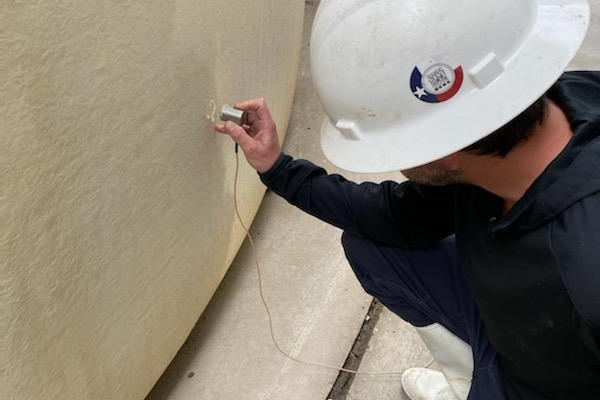
TESTING METHOD APPLICATIONS:
- Metal pressure vessels and piping
- FRP vessels and piping
- Reactors and hot circuit piping
- Heat exchangers
- Deaerators, etc.
- Tank bottom for storage tanks
- Full structural test on storage tanks
COMMON DEFECTS DETECTED:
- Material crack growth
- Active corrosion
- Rubbing
- Leaks
- Stress corrosion
- Fatigue
AE TESTING VS. SEISMIC TESTING
- Seismic industry uses low frequencies between 0-10 Hz, while AE testing uses higher frequencies between 20-400 Hz. Higher frequencies are more effective for noisy environments.
- Seismic industry places sensors miles away from the source, while AE testing places sensors approximately every 10-15 feet.